Tuesday, May 5, 2015

Feedback and guiding my students to be conversational with their learning

This year I have spent time reflecting on the fact that while my students tend to be phenomenal performers, the moment they are asked to verbalize what they are doing......crickets.....

Challenge Accepted!  


My students need to be advocates of their learning and their hard work.  I have enhanced what I am already doing in the classroom to ensure that they can have an intelligent conversation about their projects and performances without taking time away from the joy of creativity and music making.  

I have found that dedicating a minute here and a minute there to encourage my students to verbalize what they are doing is paying off.  The key has been the consistent use of simple sentence stems that can be transferred easily from movement, vocal, rhythmic and melodic reading, and instrumental activities.

Here is one tool that has been a gem in my classroom!  


Beginning polyrhythmic reading activity: Blue/Left Pat, Red/Right Pat.  Students perform rhythm from board (See visual above).  One student is chosen before (or after to keep them on their toes) to be the "funky feedbacker."  Another student is chosen to be the "feedback checker" (I don't have a catchy title for this job yet....)

The funky feedbacker's job is to simply stick to the sentence stems (from the visual), be very specific (use evidence to support their observation), and be concise (straight and to the point with a challenge of avoiding the use of "likes" "ums" and "you knows").


The feedback checker could easily answer their checklist of the funky feedbacker's job with yes or no answers.  This does not show active listening skills and proves nothing!  We take it a step further by encouraging them to be conversational and prove their own feedback of the person giving feedback!  They should:
  • Use complete sentences and site from the "text" (Hannah used specific details when she said.....)
    • The key phrase that shows active listening skills is the phrase when she/he said.  I have noticed a HUGE difference in engaging conversations within my classroom.  The students are doing this in their homeroom classrooms by using paper clips, post it notes, and highlighters when reading texts while supporting their answers with evidence, so why not transfer it to my room too?!
  • The fourth and final question is whether or not the feedbacker was able to complete the task on their own without assistance.  We take this one further by adding a challenge or action plan from one student to another.
    • Hannah was able to complete this on her own and I want to challenge her to use even more detail in her next turn.  
    • The challenge is revolving around their feedback and not their performance.  While introducing this new system in my classes, I noticed that some students default to giving performance challenges/feedback, but they are reminded to give a challenge for the student's actual feedback.  Do they want to hear more details, hear specific note names, specific measures, etc?  
      • I remind students that the challenge/action plan is coming from a place of "we are excited about what you said and want even more!"  I refer to scenarios of dessert...when it's good, you want more!  This steers the students in a direction of respect and positive communication skills, rather than feeling like they are being criticized for not doing enough.  It's all in the delivery.
Remind students that observations and feedback from an individual can be transferred to anyone and can help us all grow to become more successful musicians.  

We have gone through several changes in my building and district revolving around feedback and observations.  I have worked very hard over the years to create a climate of respect and safety in my room.  It has taken time, trust, and modeling to create a culture where students are comfortable receiving and giving feedback, critiques, and stating and receiving opinions without the default reaction of anger, sadness, and the general feeling of "I'm being picked on" or "I'm not good enough so I don't care anymore."  I have learned a lot from watching teachers receiving feedback and have want to grow from mistakes made in my work environment and the uncomfortable situations that can be created if the climate is not laid out correctly.  

Friday, March 27, 2015

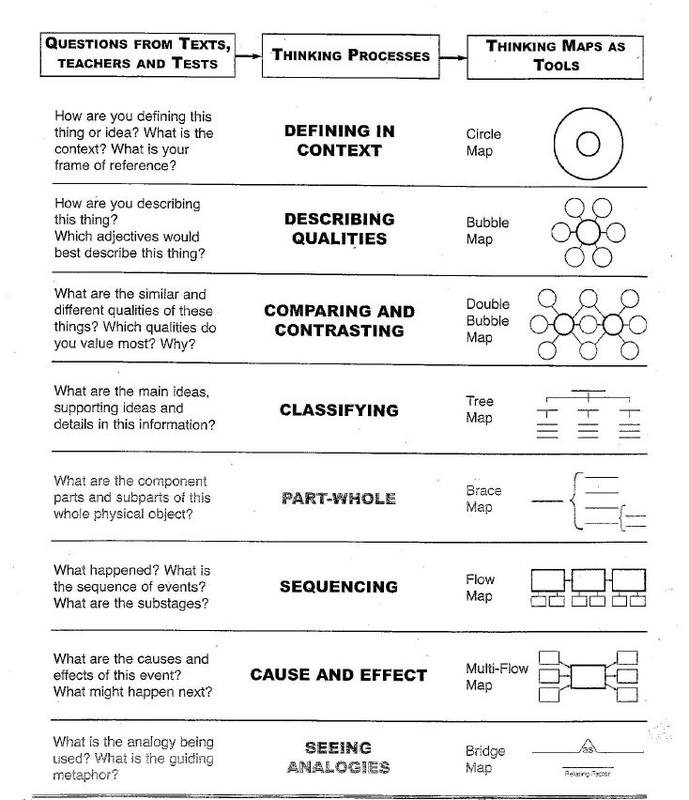
Thinking Maps

I've been incorporating Thinking Maps in whole class, small group, and individual settings in my classroom this year.  Incorporating various maps in quick and purposeful times can be woven into any concept.  

Why I'm Doing It:

  • I've seen lightbulb moments when students have a chance to describe meanings to concepts in multiple ways.
  • They can be quick and purposeful
  • They can be solo or collaborative
  • They do not take away from my movement, instrumental, creation, vocal, and other learning areas in my classroom.  I have found that they enhance these activities by allowing students to dig deeper into their learning and understanding of concepts.  
Bubble maps were created for our grade level rhythmic units.
They are displayed throughout the room for reminders throughout the year

Bubble maps were created to enhance our harmony unit to describe I, IV, V, and vi chords.
Various colors were used for different classes.
This activity was done after various movement, reaction, and instrumental activities.
Brainstorming from the harmony unit bubble maps was inputted into
Tagxedo for one more creative way to display our ideas.  
Thinking Maps

Do you utilize various thinking maps in your classroom?  I'd love to hear your ideas at generalmusicclassroom@gmail.com or feel free to share below!


Friday, September 28, 2012

Welcome Back!

Welcome Back!

I hope everyone out there tried to take some time this summer to clear their head, recharge their batteries, and get pumped for a new year of inspiring kiddos!  I wanted to share a source of continuing education that I can't seem to stop going to on my IPad.

Pinterest is a great source for the most mouthwatering recipes, new ways to assemble an outfit with the latest style trends, and instructions on how to create cheaper cleaning products using commonly found kitchen items, but there are   other gems to be found in this oh so addicting site.

I have been building an endless web of video segments, web resources, and enough curriculum maps to bring out my inner continuing education nerd!  The ability to access resources from teachers of all different methodologies from across the country without spending a dime or a Saturday at a workshop is something that I've found to be invaluable.  I challenge teachers to grab a cup of tea, sign up for an account, friend other teachers, start pinning and then start exploring and implementing these new ideas in their classrooms!  Have you found a great pin that worked wonders in your classroom?  Email me:  generalmusicclassroom@gmail.com 

Monday, April 30, 2012

Reflecting on the good, the bad, and the "gotta do's"....

As this school year comes to a close, remember to reflect on lesson plans, performance ideas, advocacy plans for your program, and professional development workshop notes with great ideas that will keep the juices flowing for the next school year.  Now that my performances have wrapped up for 2011-2012 and I find that breathing is coming a bit easier....I am excited to jot down the good, the bad, and the "gotta do's" for the 2012-2013 school year.  Here are three challenges that I find myself wanting to tackle that may help you start your reflection.  Now grab a cup of hot tea and start writing!:

  • Taking a few quick minutes each rotation to educate my students about the music blog for their school.  My goal is that this will help with parent communication, music advocacy, and providing my students educational opportunities that are reachable beyond the four walls of my classroom.
  • Commit to putting brain-based research on my paper programs for all performances.  I would also like to put this research into other areas of parent communication such as our newsletter, and possibly at the bottom of any paper activities we do in class.  I usually include research read by students while different performing groups are setting up during concerts.  I recently received an email from a parent stating that she was excited to hear that we work on crossing the midline in music class and this was something that she works on with her son with at home activities.  Every little bit of information helps!
  • As always NETWORK, NETWORK, NETWORK with other great music teachers.  Check out their blogs, workshops, and simply reach out and call! As my favorite mentor once said, "After all, it's for the kids!"  So don't hesitate to pick other teacher's brains!
As always, send your reflection ideas to generalmusicclassroom@gmail.com

Monday, February 27, 2012

Classroom blog as a communication tool....

I have been exploring the use of both a personal education blog to communicate ideas I come across with my fellow music educators as well as a blog for my classroom to communicate day to day happenings.  I have found the classroom blog to be an extremely effective communication tool.  I am able to post pictures, videos, links to advocacy resources, and much more in a short amount of time.  My goal is that parents get an inside glance at the overwhelming amount of material that we cover throughout the year.

There are so many user friendly blog sites to utilize these days so my advice to you is pour a cup of tea and just start experimenting with one that speaks to you!  I had a sixth grade student comment the other day to his class, "Did you see what those first and second graders can do?  I saw it on the music blog!!"  This alone made my day and my blogging project worth it.....

Keep me posted with your blogs and online communication tools/ideas @ generalmusicclassroom@gmail.com

Monday, February 13, 2012

Could a postcard bring a bit of confidence, happiness, and music advocacy?

At a recent professional development, a fellow music teacher mentioned that she sends out postcards to students as an outlet for positive communication. Well, I loved the idea and jumped online to get started.  I created postcards utilizing a fun pre-made design and added a music advocacy quote.  It's the best of both worlds, music advocacy for the parents (and kiddos too...) and a positive note for the student.  As specials teachers, we have so many kids that making personal connections with every single one can be a bit of a challenge.    These postcards are one more way to tackle this!

Hop online to any print/paper website and design away.  The pricing for mine wasn't bad at all and I am excited to see results!

Monday, February 6, 2012

Incorporating video segments into your lesson plans for improved student learning....

I've been checking out professional development courses lately that have been challenging teachers to incorporate video segments into their lesson plans to improve student learning and student memory.  Of course, I immediately want to tackle yet another project, however, as a lot of teachers say, I just need a bit more time!  
At a recent staff meeting, a teacher showed a video completed by two students incorporating information they had previously learned about the Bill of Rights using the online resource  xtranormal.com.  I was hooked! The teacher was able to assess student understanding of the subject matter, and I bet the students will remember the key points to the lesson for a long time to come due to the creative outlet!  
The ability to quickly and effectively utilize this tool has motivated me to quit waiting for the right time and just start creating!  Check out the video above for more of my ideas, then go to xtranormal.com and create one for yourself...It's as easy as the slogan says, "if you can type...you can make movies!"